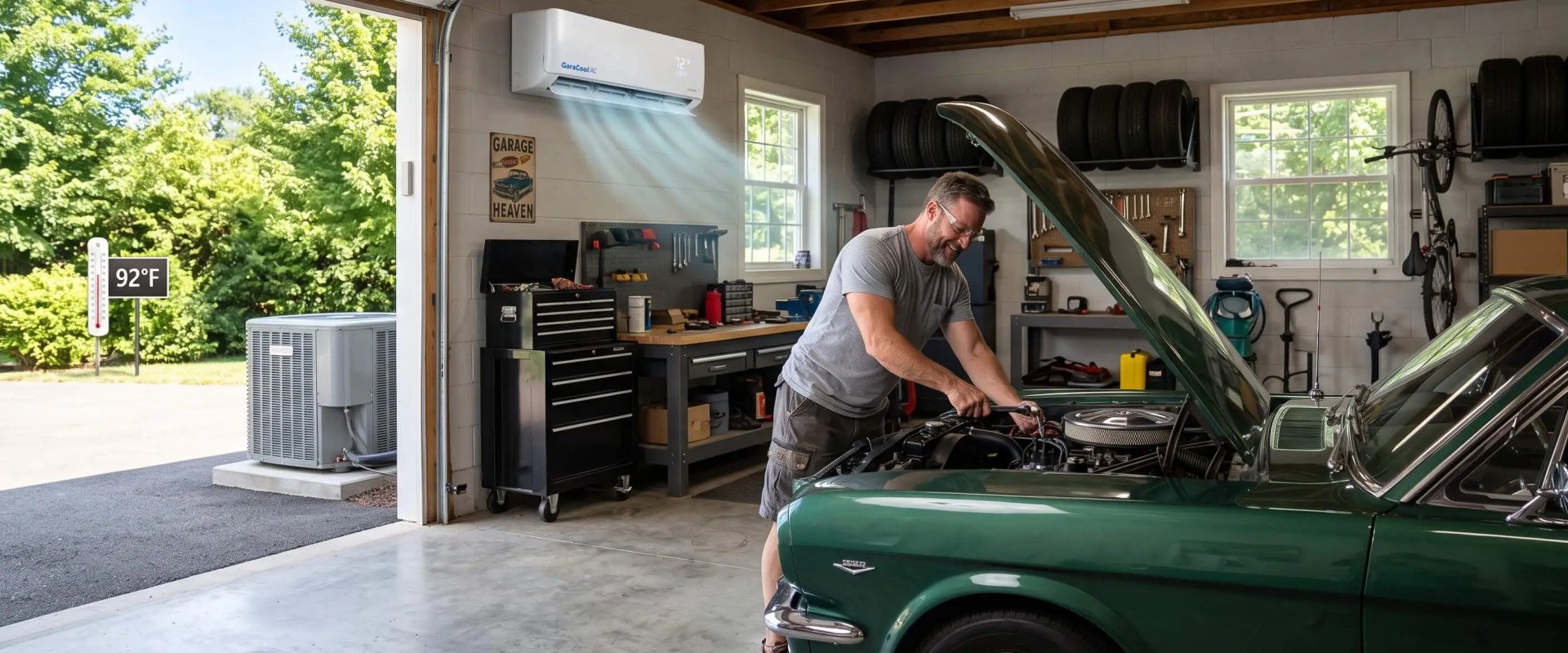
Last August I set a thermometer on a workbench inside a closed two-car garage. Outside it read 94 degrees. Inside it read 118, and the homeowner had spent the previous ten minutes telling me he just needed something small, nothing fancy.
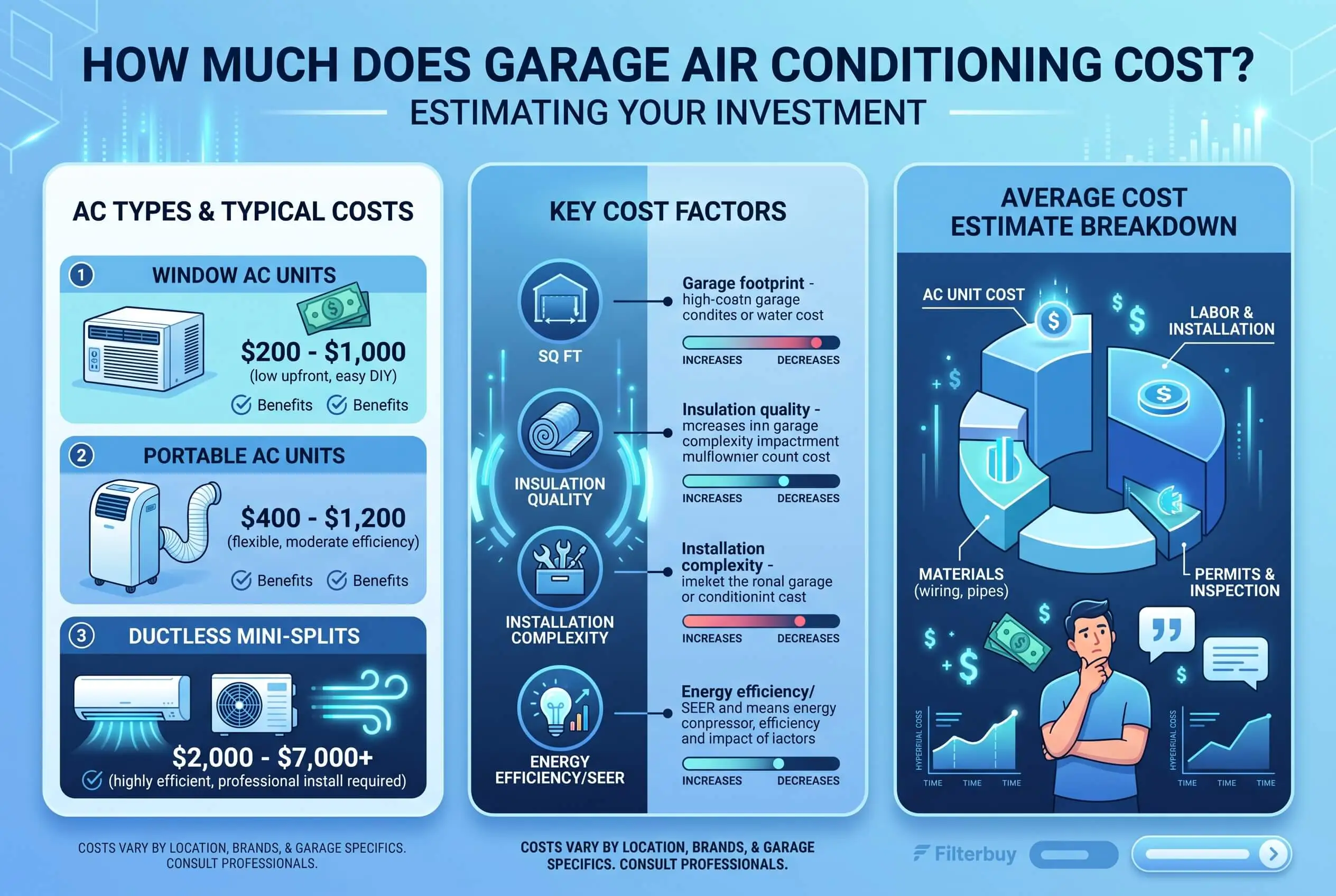
Garage cooling runs somewhere between $400 and $6,500 installed. That's a wide spread, and where you land inside it comes down to which type of system suits the space and how much electrical work the garage needs before anything will run. A garage air conditioner at $500 and one at $5,000 can both be the correct answer. Depends on what you use the space for.
I've sized cooling for single-car garages, converted home gyms, and a detached workshop with an air compressor cycling all afternoon. The sticker price has never once told the whole story. A garage air conditioner delivers the best results when it's matched to the way the garage is actually used.
TL;DR Quick Answers
Garage Air Conditioner
A garage air conditioner has to fight heat a house system never sees, since a closed garage runs 20 to 30 degrees hotter than the air outside. A ductless mini split handles that load best. Portable and window units will cool the space, though both struggle without insulation.
Ductless mini split: the strongest option. No ductwork, works with no window, and heats in winter too.
Window unit: cheapest to buy, but only if the garage has an opening that fits one.
Portable unit: no installation at all, though the exhaust hose gives back much of the cooling.
Size it to the space: 9,000 to 12,000 BTU for a one-car garage, 12,000 to 18,000 for a two-car.
Insulate before you buy: sealing the door drops the load, which drops the unit size you need.
Top Takeaways
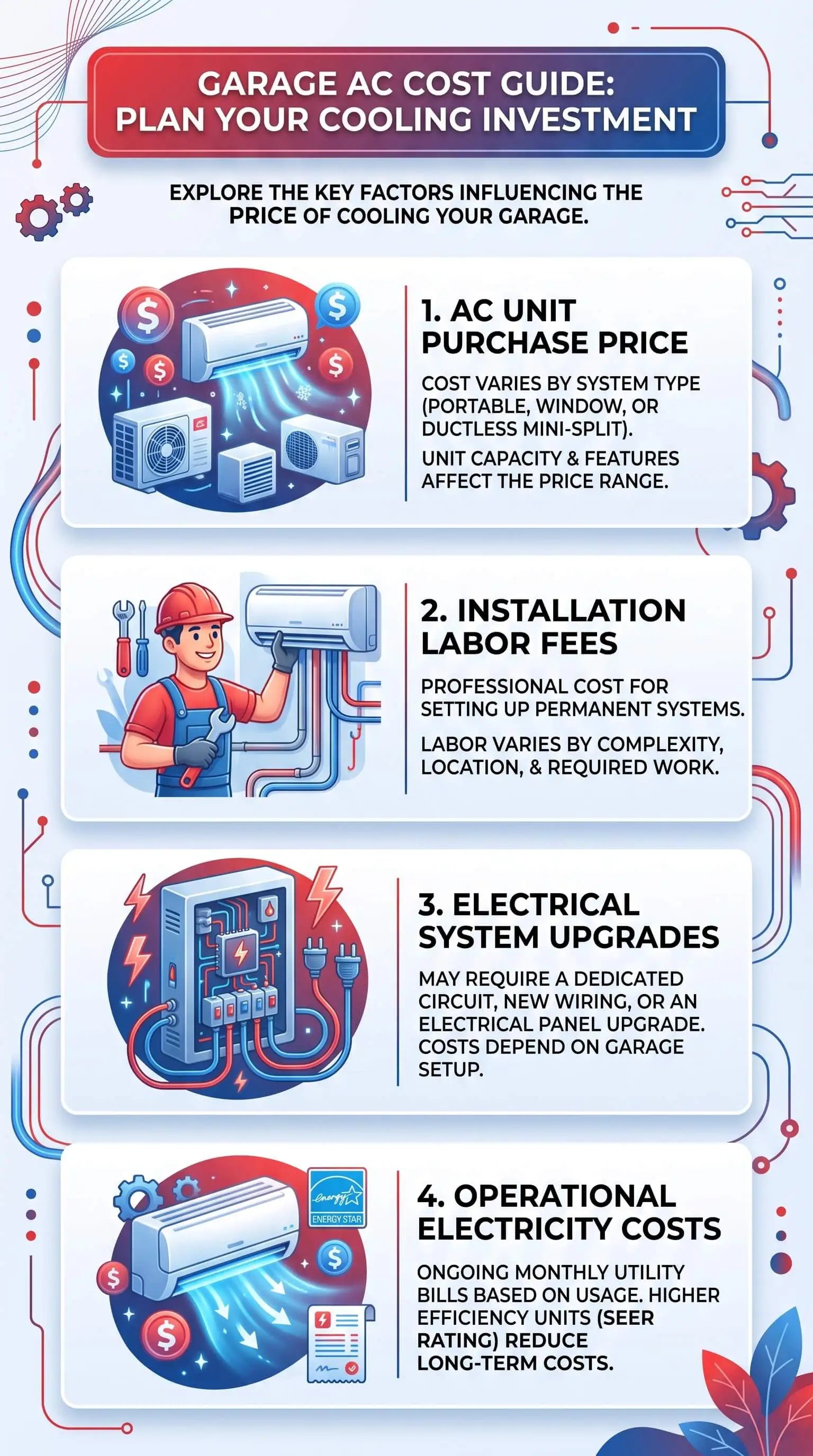
Budget $400 to $6,500 installed, and expect installation to match or beat equipment cost on any permanent system.
Insulate the door and seal the gaps before you size anything, because a smaller load buys you a smaller unit and a smaller bill.
Size to the space rather than to the biggest unit your budget allows, since oversizing leaves you with a cool garage that still feels damp.
Ask whether the quote covers a load calculation, a dedicated circuit, and permits. Those three items account for most of the gap between competing bids.
Work out the running cost yourself from rated wattage, honest run hours, and your own utility rate before you sign anything.
What Actually Drives Garage Air Conditioning Cost
Five things move the number on a garage quote, and only one of them is the unit itself.
Square footage sets the baseline. Insulation condition tells me whether that unit will loaf along at half capacity or run flat out from two o'clock until sundown. Sun exposure on the door and the exterior walls piles heat on top of that. Ceiling height matters because you're cooling volume, not floor area. Plenty of garages hold nine or ten feet of hot air above the bench that nobody counts. Electrical capacity decides whether an electrician pulls a new circuit or just lands a breaker in an open slot. Understanding these factors is essential to choosing the right HVAC system for reliable comfort, efficiency, and long-term performance.
All five land on the invoice. They show up either in the size of the unit I specify or in the labor to get power to it. A 400 square foot garage with a bare metal door facing west can need more capacity than a shaded 500 square foot garage on the north side of the house.
Garage Air Conditioner Cost by System Type
Every option below moves heat out of the space rather than creating cold, which is the whole trick behind modern air conditioning. What separates them is where that heat ends up and how much of your money it takes to send it there.
Portable Units
$300 to $700, no installer required. You wheel one in, run the exhaust hose out a window or through a wall vent, and plug it in.
Here's what the box won't tell you. Single-hose designs cool their own condenser using air from inside the room, so they're constantly pushing conditioned air out through the hose while hot outside air seeps back in through every gap in the building. The unit does its job. The garage just keeps refilling with heat behind it. They also eat floor space you probably wanted for a bench.
Window Units
$200 to $800 for the equipment, plus a bracket or a wall sleeve if the opening needs one. Per dollar spent, they cool harder than portables do. Most garages have no window suitable for one, which knocks them out of the running long before price comes up.
Ductless Mini Splits
This is what I specify for garages people actually use. Equipment runs $900 to $2,500 for a single-zone system in the 9,000 to 24,000 BTU range. Professional installation adds $1,200 to $3,500 on top of that, depending on line set length, wall construction, and how much the electrical side of the job demands.
You get heat along with the cooling. The operation stays quiet enough to take a phone call standing under the head unit, there's no ductwork, and the thing works fine in a garage without a single window in it. For the options laid out against a real garage before you commit, this guide on how to cool a garage walks through each one. And if you're still working out where ductless sits in the wider category, this explainer on whether mini splits count as HVAC sorts that out.
How Sizing Moves the Price
Capacity gets measured in BTU. These are the bands I work from:
9,000 to 12,000 BTU for a one-car garage in the 200 to 300 square foot range
12,000 to 18,000 BTU for a two-car garage in the 400 to 600 square foot range
18,000 to 24,000 BTU and up for three-car garages and anything with tall ceilings
Buy more capacity than the space needs and you'll pay for it twice. Once at purchase, then again in comfort, because an oversized unit hits the setpoint fast, shuts down, and never runs long enough to wring the moisture out of the air. That's the garage reading 74 degrees on the thermostat that still feels like a basement. Undersizing announces itself the other way, as a unit that runs from noon until dark and never quite arrives. Proper sizing from the start also helps you get the most value from an AC replacement, delivering better comfort, efficiency, and long-term system performance.
Installation and Electrical Costs
Labor and electrical are where two quotes on the same garage separate by thousands of dollars.
A mini split needs a mounting plate, a three-inch hole for the line set, a pad or wall bracket for the condenser, a condensate route that drains somewhere sensible, and a dedicated circuit. Units around 12,000 BTU often run on 115V. Anything at 18,000 BTU and above generally wants 230V, which means a two-pole breaker and a fresh run from the panel. I've watched the electrical portion land at $400 on an attached garage where the panel sat directly on the other side of the drywall, and at $1,800 on a detached garage that needed a trench dug across the side yard.
Mechanical and electrical permits apply in most jurisdictions, and inspection follows. A contractor who puts them on the quote is being straight with you. A contractor who leaves them off hasn't made the job cheaper, he's just moved that cost somewhere you can't see it yet.
What It Costs to Run Each Month
The running cost is arithmetic, and you can do it yourself in about thirty seconds. Take the unit's rated wattage, divide by 1,000 for kilowatts, multiply by the hours you honestly run it, then multiply by the rate per kilowatt hour printed on your bill.
A 12,000 BTU inverter mini split pulling around 900 watts, runs six hours a day, uses roughly 162 kilowatt hours in a month. At 16 cents per kilowatt hour, that's about $26. Run the same math on a portable unit drawing 1,300 watts and you get a bigger number for less cooling, which is the part nobody brings up in the aisle.
Anyone weighing operating cost across system types will get something out of this comparison of mini split versus central AC operating cost, and this look at which AC types are most energy efficient explains where the efficiency actually comes from.
Where the Money Saves Itself
The cheapest capacity is the capacity you never have to buy.
Insulate the door, seal the perimeter, and the load drops. A smaller load lets me specify a smaller unit, and a smaller unit costs less to buy and less to run every month afterward. On a two-car garage last summer, a door insulation kit plus a fresh bottom seal and sealed side gaps pulled the calculated load down far enough to move my recommendation from 18,000 BTU to 12,000 BTU. The materials cost less than what that one change saved on equipment and electrical.
Seal and insulate the garage before installing cooling equipment, then maintain the system with a clean MERV 8 pleated HVAC air filter to support efficient airflow, better performance, and long-term comfort.
"The garages I get called back to twice are almost always the ones where somebody bought the unit before anybody looked at the door."
7 Essential Resources
Match the Unit to the Space Before You Shop
Sizing guidance from the certification program itself, including why your contractor should confirm capacity with a Manual J calculation instead of a rule of thumb. Read it before you accept anybody's BTU number. ENERGY STAR: Ductless Heating and Cooling
Cut the Load Before You Pay for Capacity
How to find air leaks and shut them. This is the highest-return dollar in most garage cooling projects, and the fact sheet covers materials, methods, and what to ask a contractor for. Department of Energy: Consumer Guide to Air Sealing the Home
Know Why Refrigerant Work Requires a Certified Tech
Federal rules require certification for anyone who opens a refrigerant circuit. The certification types listed here hand you the exact question to ask when you're vetting an installer. EPA: Section 608 Technician Certification
See the Standard Your Contractor Should Be Sizing To
Manual J is the recognized standard for residential load calculation, and national building codes plus most local jurisdictions require it. Knowing the document exists changes how the conversation with a contractor goes. ACCA: Manual J Residential Load Calculation
Check a Unit's Rated Performance Before You Pay for It
Independent performance certification for HVAC equipment, searchable by product line, rating, or brand. Use it to confirm the capacity and efficiency figures on your quote match what the manufacturer actually certified. AHRI: Directory of Certified Product Performance
Protect the Garage Circuit Before You Plug Anything In
Garage receptacles carry ground fault protection requirements, and a portable unit on a marginal circuit trips them regularly. This one explains how the protection works and where it belongs. CPSC: What Is a GFCI?
Read What the Mechanical Code Expects From the Install
General mechanical requirements from the residential code, covering equipment installation, access, and clearances. Good context for why a permitted install costs what it costs. ICC: General Mechanical System Requirements
Proper sizing, air sealing, certified installation, and regular maintenance with high quality air filters help maximize garage cooling performance, improve energy efficiency, and keep your HVAC system operating reliably for years to come.
3 Statistics Worth Knowing
Air conditioning accounted for about 19 percent of the electricity used in United States homes in 2020, or roughly 254 billion kilowatt hours. Treat your garage unit's monthly draw as a real budget line, because it behaves like one. U.S. Energy Information Administration
Of the 686,000 new single-family homes sold in 2024, 75 percent in the South came with a two-car garage and 10 percent with a one-car garage. Two-car footprints dominate new construction, which is exactly why the 12,000 to 18,000 BTU band covers most of the quotes I write. U.S. Census Bureau
Heating, air conditioning, and refrigeration mechanics and installers earned a median $28.75 an hour, or $59,810 a year, as of May 2024. Skilled labor priced that way is why installation often costs more than the equipment on a garage job. U.S. Bureau of Labor Statistics
Most garages fall within common residential cooling ranges, but local climate, energy costs, and even cities that lack air conditioning highlight why proper sizing and efficient installation matter for long-term comfort and operating costs.
Final Thoughts and Opinion
Give me a fixed budget for a garage somebody genuinely uses and I'll spend the first few hundred dollars on the door and the gaps before I spend a nickel on equipment. That sequence has changed the recommended unit size on more jobs than any other factor I track. It's also the least satisfying advice I give anybody, because nobody has ever gotten excited about weatherstripping.
The pattern I run into most often goes like this. Somebody buys a portable unit in July out of frustration, runs it hard through two summers, then calls me to install the mini split they should have started with. Counting both purchases, they spent more than one correct install would have cost.
So here's my honest read. A garage used for storage needs a fan and a door seal, and that's the end of it. A garage doing duty as a gym, a shop, or an office deserves a properly sized mini split put in by somebody licensed to do the work. Pairing that system with pleated furnace filters helps maintain cleaner airflow, supports efficient HVAC performance, and keeps the space more comfortable over the long term. Anything in between, measure first and decide after.
Frequently Asked Questions
Is a mini split worth it for a garage?
Yes, for any garage doing duty as a gym, workshop, or office. Mini splits cool without ductwork, runs quietly, handles heat in the cooler months, and works in garages that have no window to put anything in. The upfront premium comes back twice, in running cost and in usable square footage.
What size AC do I need for a two-car garage?
A two-car garage in the 400 to 600 square foot range usually needs 12,000 to 18,000 BTU. Thin insulation, tall ceilings, or hard afternoon sun push you toward the top of that band. Run a load calculation on the actual building.
Do I need a permit to install AC in a garage?
Usually yes. Most jurisdictions require mechanical and electrical permits for a permanently installed system, with inspection to follow. Portable units that plug into an existing receptacle generally need nothing. Call your local building department before work starts, since requirements shift by city and county.
Can a window unit cool an uninsulated garage?
It'll lower the temperature, though it will struggle and cost more to run than it should. An uninsulated door and bare walls let heat back in about as fast as the unit removes it. Insulate first and a smaller, cheaper unit will hold the space comfortably.
How much does insulation reduce garage cooling cost?
Enough to change which unit you buy. On one two-car garage, a door insulation kit and sealed perimeter dropped the calculated load out of the 18,000 BTU band and into the 12,000 BTU band, which cut equipment and electrical cost together. Monthly operating savings stack on top of that.
Why does my garage AC struggle even though it is sized correctly?
Check the envelope and the airflow before you blame the unit. An open door, an unsealed bottom seal, a loaded filter, or a blocked condenser will each defeat correct sizing on its own. Hot vehicles parked inside and tools running add load that no sizing calculation saw coming.
Price the Garage, Not Just the Unit
Measure the space, check whether that door has any insulation in it at all, and find out how much room your panel has left before you call anybody for a quote. Keep in mind that standard HVAC air conditioner sizes for homes are only a starting point, since garages often require different sizing based on insulation, ceiling height, and usage. Those three numbers turn a vague estimate into one you can hold up against three others.